How to Practice Hand Sewing (Without Needing Something to Show For It)
One of the unspoken pressures beginners feel with sewing is the idea that every stitch should turn into something useful.
A pouch.
A hem.
A project that proves you’re “really” learning.
But hand sewing doesn’t actually work that way — especially at the beginning.
In the early stages, the most helpful thing you can do is practice without expecting a finished object. Not because projects aren’t valuable, but because learning how sewing feels comes before learning how to make something with it.
Practice is how:
- Your hands get steadier
- Your stitches get smoother
- Your confidence quietly grows
And none of that requires a real project yet.
Here’s how to practice hand sewing in a way that builds skill without pressure.
Practice Is Not a Placeholder — It’s the Work
When you’re new to hand sewing, your hands are learning:
- How to hold the needle comfortably
- How tight or loose stitches should feel
- How fabric behaves under tension
- How rhythm develops stitch by stitch
None of that requires a pattern.
Practice pieces — small, uneven, imperfect ones — are not failed projects. They are exactly where skill develops.
If you let practice be enough, sewing becomes more relaxed almost immediately.
The Best Way to Practice: Small, Simple Pieces
Instead of aiming for something finished, start with small pieces of fabric and repeat the same motion.
For example:
- Cut a small square of scrap fabric
- Draw a few straight lines with a pencil
- Sew along the lines using one stitch
- Stop when your hand feels tired
That’s it.
You can:
- Pull it apart and start again
- Try a different stitch
- Change thread thickness
- Change fabric thickness
- Switch needle sizes
Nothing needs to be saved.
Nothing needs to be perfect.
Repetition Is How Hands Learn
Hand sewing is learned through muscle memory, not instructions.
The most helpful practice is often the simplest:
- Sew ten running stitches
- Pull them out
- Sew them again
Each time:
- Your tension improves
- Your spacing evens out
- Your hands relax a little more
Progress happens quietly.
A Perfect Practice Skill: Sewing on a Button
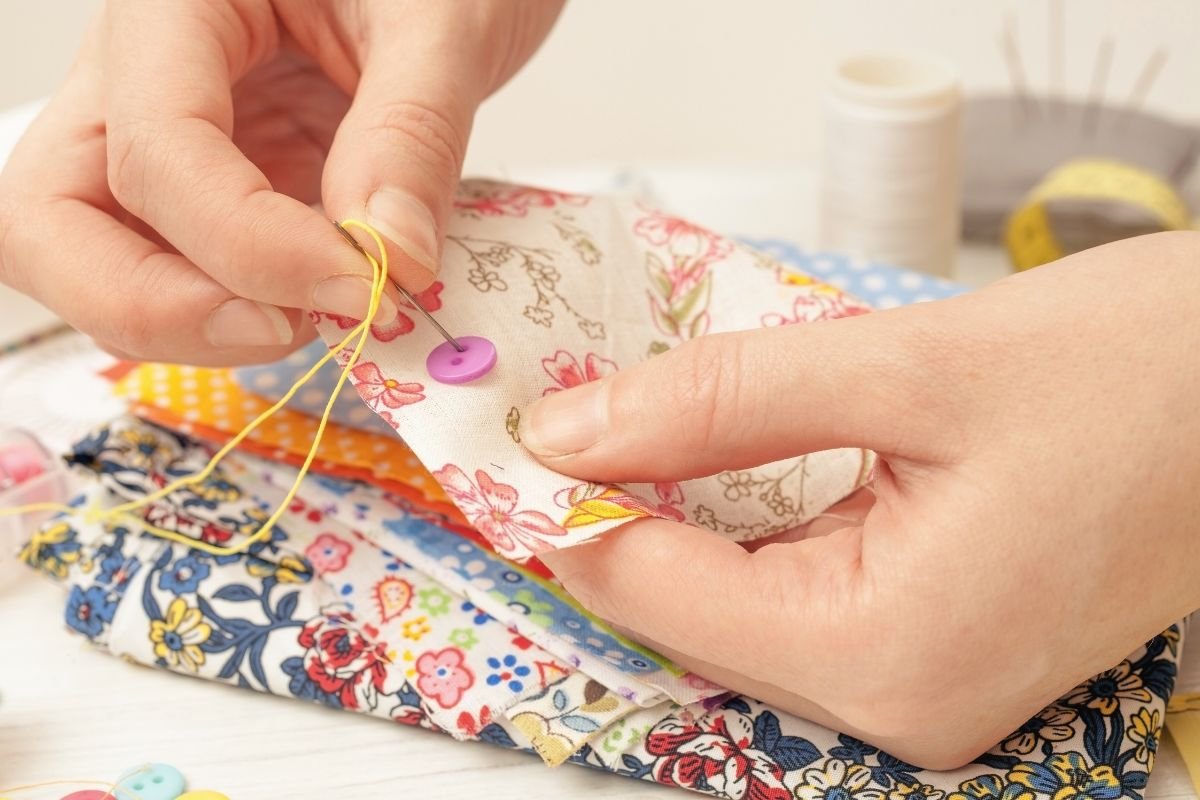
If you’d like a practice exercise that’s both useful and satisfying, sewing on a button is one of the best places to begin.
Why it’s perfect for beginners:
- Small and manageable
- Teaches stitch control
- Builds confidence quickly
- Immediately practical
You can practice on:
- Scrap fabric
- An old shirt
- A loose button that needs reattaching
Try:
- A simple two-hole button
- Then a four-hole button
- Practice keeping stitches neat and even
- No one sees the backside of a button anyway — which makes this an excellent place to learn without pressure.
And someday, when a button pops off at the worst possible moment, you’ll be very glad you practiced.
Focus on Feel, Not Appearance
During practice, try not to judge how things look.
Instead, notice:
- Does the needle move smoothly?
- Are your fingers tense or relaxed?
- Are stitches easy to pull through?
- Does your thread tangle often?
These sensations matter more than straight lines right now.
Appearance improves naturally once your hands settle into the motions.
Short Sessions Count More Than Long Ones
You don’t need an hour.
Ten or fifteen minutes is plenty — especially at the beginning. Hands tire quickly, and frustration arrives faster than you expect.
Stopping early, while things still feel okay, makes it easier to come back tomorrow.
Consistency builds skill.
Marathon sessions rarely do.
Practice Without Pressure Builds Confidence
When you remove the expectation of a finished object, something shifts.
You’re more willing to:
- Try again
- Make mistakes
- Pull stitches out
- Experiment
- Notice improvement
That quiet confidence is what eventually makes projects feel possible — and enjoyable.
If you’re still gathering supplies or refining your tools, this guide on beginner hand sewing supplies walks through what actually helps at the beginning.
And if you’re still getting comfortable with how to learn hand sewing without overwhelm, this guide can help you slow things down and find your rhythm.
Let Practice Be Enough
Hand sewing doesn’t need to produce something impressive to be worthwhile.
Practice stitches.
Uneven rows.
Buttons sewn slightly crooked.
Scraps that never become anything else.
These are not signs that you’re behind — they’re signs that you’re learning.
When you let practice be the goal, sewing becomes what it’s meant to be: steady, grounding, and quietly satisfying.
You’ll have plenty of time for projects later.
There’s no rush.
No pressure.
Remember: one stitch at a time.